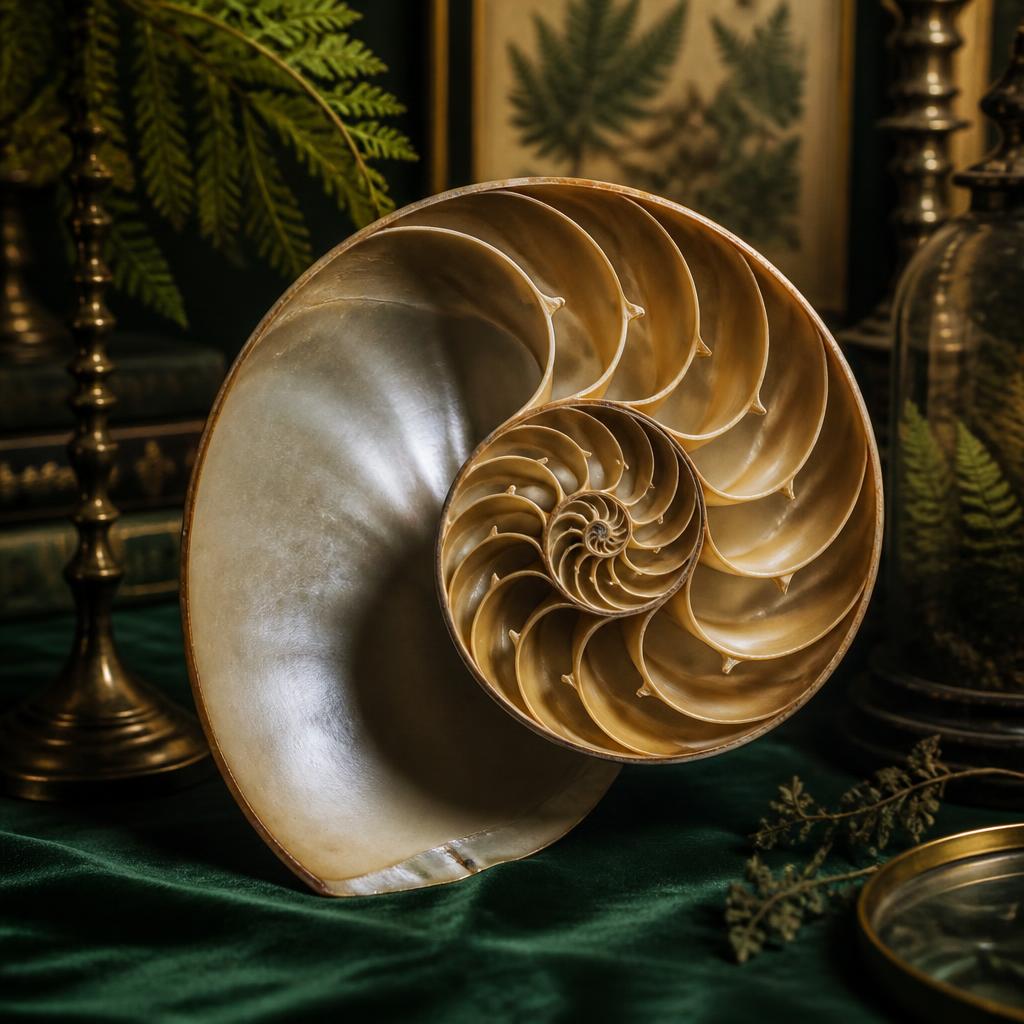
The developmental biology behind the famous spiral.
That sunflower heads arrange their seeds in Fibonacci spirals is one of the more famous facts of biology-adjacent trivia. Like most famous facts, it is both true and considerably more interesting than the trivia version.
The Fibonacci sequence — 1, 1, 2, 3, 5, 8, 13, 21, 34... each number the sum of the previous two — has a distinctive property. Adjacent numbers' ratios approach the golden ratio, φ, approximately 1.618. Angles based on this ratio, specifically 360°/φ² ≈ 137.5°, are called the golden angle.
When a growing plant produces new elements — leaves along a stem, seeds in a flower head, florets on a pineapple — one of the simplest developmental rules it can follow is: put the next element at the golden angle relative to the previous. This rule packs the elements more efficiently than any other constant angle, because the golden ratio is, in a precise mathematical sense, the 'most irrational' number — it cannot be well-approximated by any simple fraction, so successive placements never overlap or line up.
The result, when you draw it out, is the double-spiral pattern of the sunflower head. The numbers of spirals in each direction are consecutive Fibonacci numbers, not because the plant is 'counting' but because that is what the golden-angle rule produces.
The developmental biology is now well-mapped. Plant hormones — particularly auxin — create zones of inhibition around newly initiated primordia. The next primordium tends to arise at the location of least inhibition, which turns out, for reasons of geometry and diffusion, to be close to the golden-angle position.
Nothing in this story requires the plant to 'know' the golden ratio. The mathematics is emergent, not encoded. What the plant knows, in its distributed developmental way, is: put the next thing where the concentration of inhibitor is lowest. Everything else follows.
This is a useful correction to the more mystical readings of Fibonacci in nature. The pattern is real. It is not magic. It is what happens when a particular class of growth rule runs in a particular geometric setting. Where the rule does not apply — and it does not always — the pattern does not appear.
That makes it more interesting, not less. Nature does not tile according to Platonic templates. It grows according to local rules, and some of those rules produce, as a side effect, the exquisite regularities that made mystics of us to begin with.
The sunflower is doing chemistry. The spiral is what chemistry looks like when it grows.
"Nature does not tile — it grows."
Fractal Coastlines and the Mandelbrot Set
Self-similarity from mathematics to geography.
Murmurations: Emergence in Starlings
Local rules, global ballet.
L-systems: Grammar for Growing Things
A tiny formal language behind ferns and trees.
Sign in to join the conversation. Guests can read every reply.
Loading conversation…