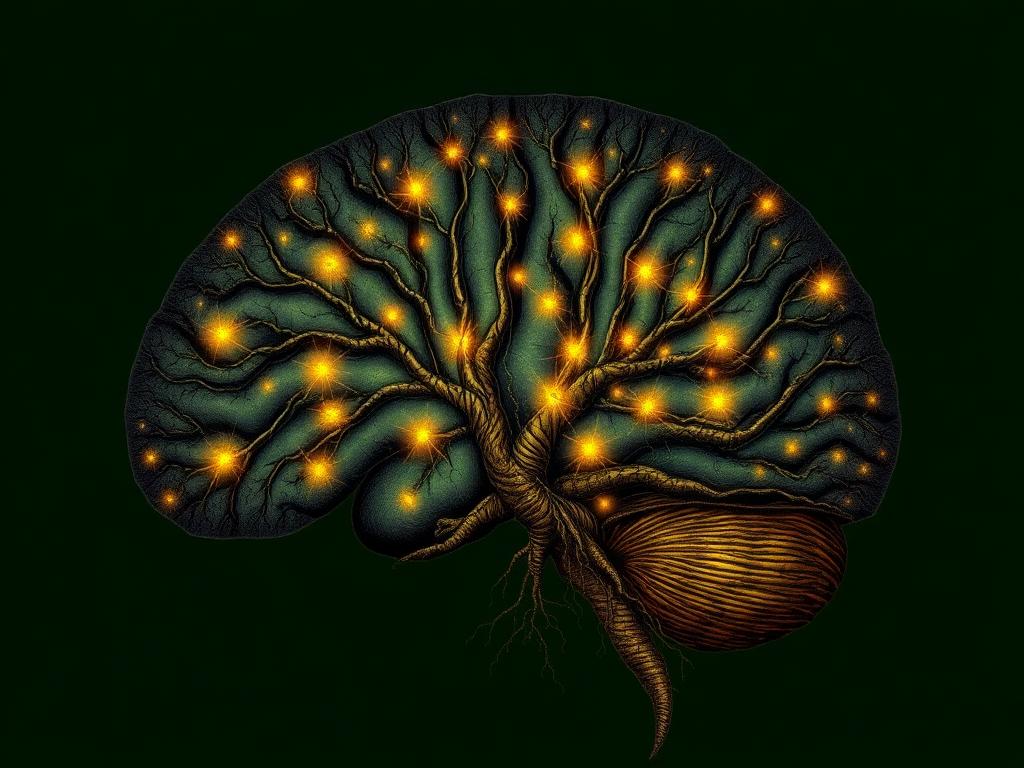
Why explaining function still leaves experience unaccounted for.
David Chalmers coined 'the hard problem of consciousness' in 1994, but the underlying puzzle is older — perhaps as old as reflective thought. The puzzle is this: even a complete functional and neurobiological account of the brain seems to leave the felt quality of experience unexplained. Why does any of this feel like anything at all?
The 'easy problems' — discrimination, integration, reportability, attention — are easy only by comparison. They are difficult scientific problems, but they are the kind of difficult that neuroscience knows how to work on. Given enough time and data, we can hope to solve them.
The hard problem is different in kind. It asks why a system that discriminates, integrates, reports and attends should be accompanied by phenomenal experience — by the redness of red, the achiness of an ache, the felt presence of the moment. Nothing in physics seems to require it. Yet here it is, or so it seems, in you and probably in me.
Positions on the hard problem tend to cluster in a small number of families. Physicalists argue that experience just is a certain kind of brain activity, and that the intuition that something is left over is a persistent cognitive illusion. Illusionists — a subset — argue more strongly that phenomenal consciousness is not what it seems even to introspection.
Property dualists accept that experience is real and irreducible but hold that it emerges from physical systems arranged in the right way. Panpsychists go further, proposing that experience — or its most basic ingredient — is fundamental to reality, distributed in some form throughout matter.
Each family has serious philosophers doing serious work. None has produced a knock-down argument against the others. That is unusual in a field where progress is possible. It suggests either that the question is malformed or that the tools we have are not yet fine enough.
The scientific developments of the last three decades have not dissolved the problem, though they have sharpened it. Integrated Information Theory offers a mathematical measure of the 'quantity' of consciousness a system possesses. Global Workspace Theory offers a functional architecture. Predictive processing offers a mechanism. Each captures something. None fully answers Chalmers's original challenge.
The contemplative traditions have their own long history with this question. They tend to approach it not as a problem to be solved but as an invitation to look — to attend, closely and repeatedly, to the felt fabric of experience itself. This is not the same as neuroscience. It is not opposed to it either.
Whatever the resolution eventually looks like — if there is one — it will probably not resemble the tidy either/or debates of the 1990s. It will more likely be a strange synthesis, one that takes seriously both the physical embedding of experience and the fact that it is, indisputably, something.
Half a century on, the problem remains what Chalmers called it. Hard.
Integrated Information Theory: A Primer
Phi, exclusion, and a math of consciousness.
Global Workspace and Attention
Broadcasting, competition, and access consciousness.
Non-Dual Awareness Across Traditions
Advaita, Dzogchen, and the recognition of nature of mind.
Sign in to join the conversation. Guests can read every reply.
Loading conversation…