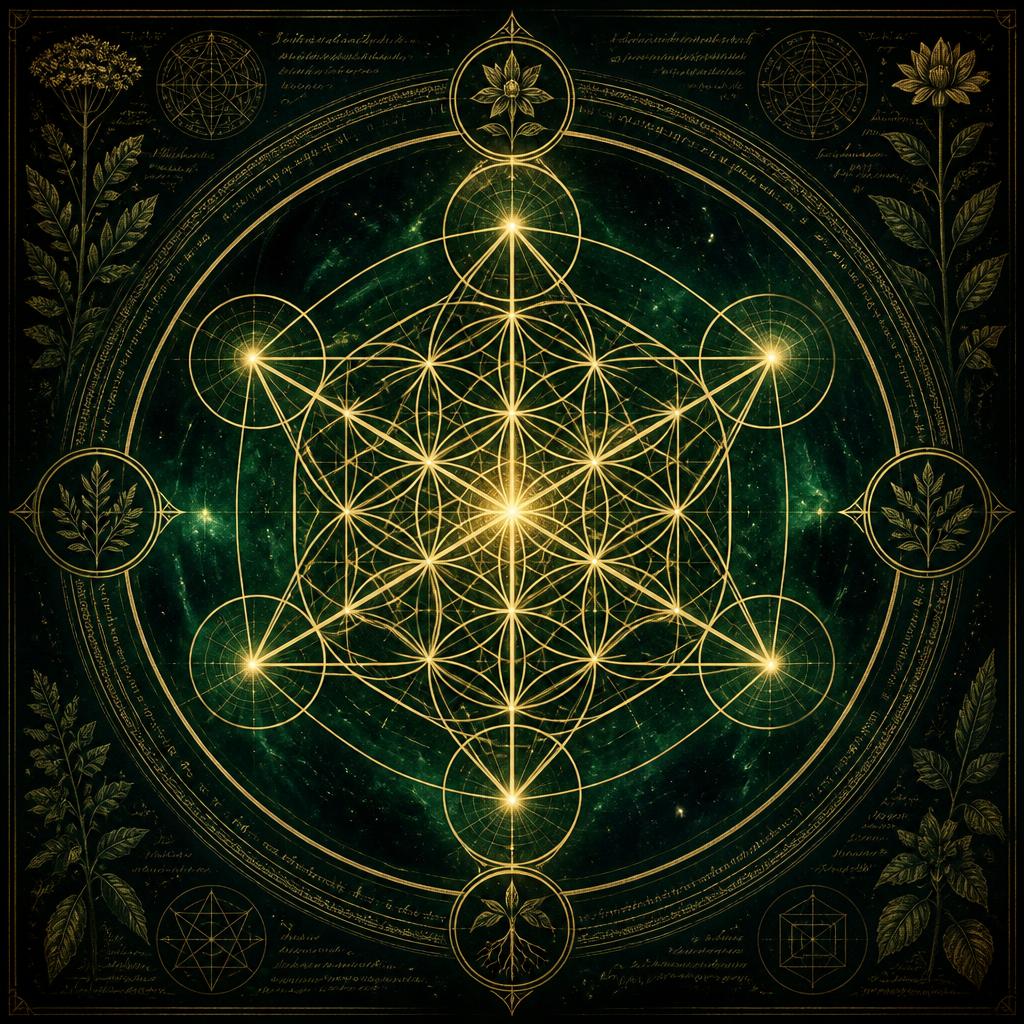
Nested geometries that recur across traditions.
Metatron's Cube is constructed by drawing lines between the centers of the thirteen circles of the Fruit of Life. The resulting figure is dense, symmetric and, at first glance, ornamental. On closer inspection it is something else: a two-dimensional projection containing the shadow of every one of the five Platonic solids.
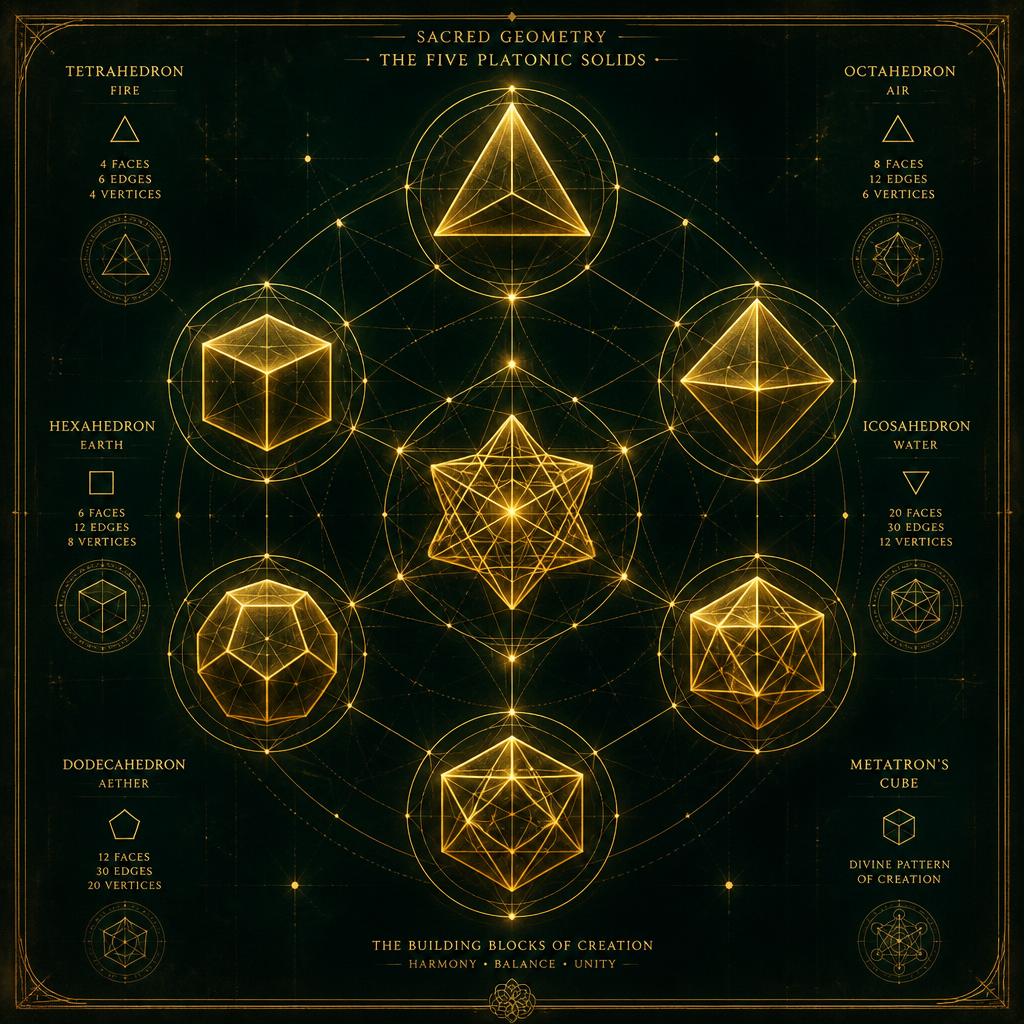
The Platonic solids — tetrahedron, cube, octahedron, dodecahedron, icosahedron — are the only fully regular convex polyhedra possible in three-dimensional space. Their exhaustiveness was proved by Euclid. Their appeal to mystics and mathematicians alike derives from this closure: there are exactly five, and no possible sixth.
That all five can be extracted from a single planar figure is not a mystical claim. It is a geometric one, provable with a pencil and patience. Whether the extraction is significant beyond its beauty is a separate question.
The name Metatron comes from a specific angelology in the Jewish mystical tradition; the association of the figure with that name is later and layered. Setting the theology aside, the diagram remains what it is: an elegant compression of the finite family of regular solids into a single planar image.
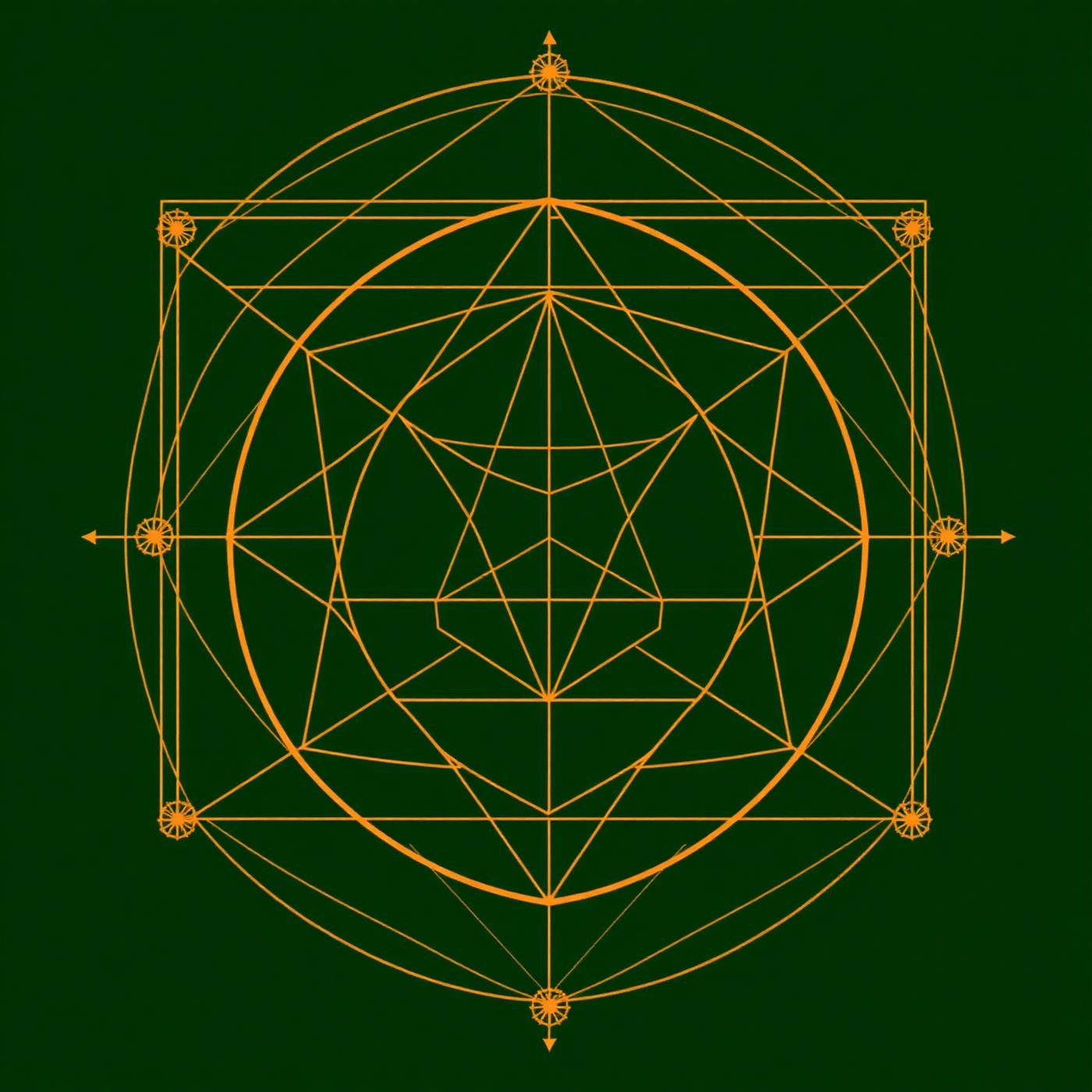
The Flower of Life: History and Structure
From Abydos to modern pattern language.
Sacred Geometry in Islamic Architecture
Girih tilings and the mathematics of devotion.
Vesica Piscis: Overlap as Symbol
Two circles, one shared eye — a small figure with a long shadow.
Sign in to join the conversation. Guests can read every reply.
Loading conversation…