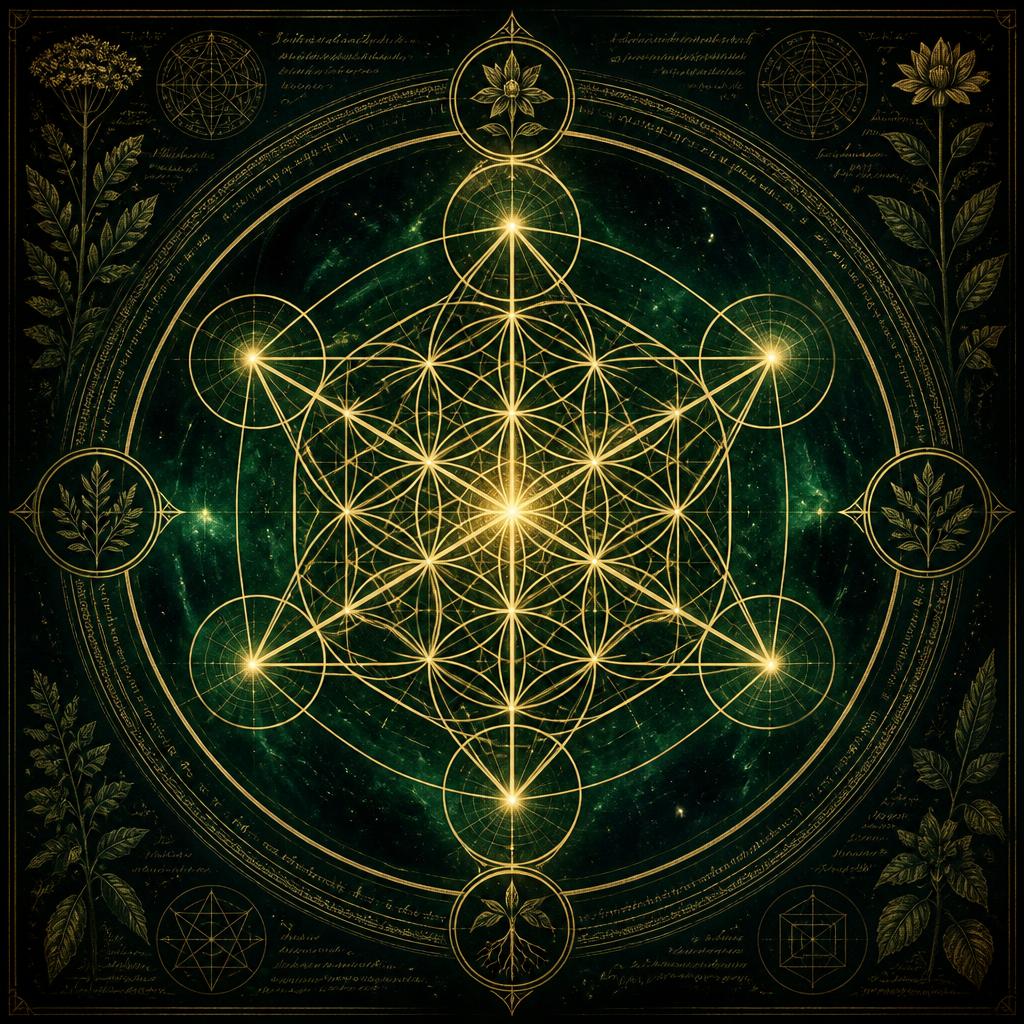
From Abydos to modern pattern language.
The Flower of Life is a pattern of overlapping circles arranged in a hexagonal lattice — nineteen circles in its most familiar form, but extensible indefinitely. It is one of the most widely reproduced sacred-geometric motifs, appearing in traditions as separated in time and geography as ancient Egypt, medieval Europe, and modern esoteric design.
The oldest confirmed examples are inscribed on granite columns at the Osirion, at Abydos, in Egypt. The technique — the pigment appears to have been applied rather than carved — has led to debate about their true age; conservative dating places them in the first millennium BCE, though later application onto a much older structure is possible.
What is not debated is that the pattern reappears independently. It shows up in Roman mosaics, in medieval Christian manuscripts, in Chinese temples, in Islamic geometric ornament. The lattice is simple enough to be independently discovered by anyone with a compass and time, and beautiful enough that many did.
Structurally, the Flower of Life is a piece of applied Euclidean geometry. Every circle is the same radius. Every center sits on the circumference of six neighbors. From this simple rule, an astonishing amount of derivable structure follows: the vesica piscis (the overlap of two adjacent circles), the seed of life (seven circles), the fruit of life (thirteen), and by connecting the centers of the fruit of life, the diagram called Metatron's cube — from which the two-dimensional projections of all five Platonic solids can be drawn.
This is the source of the pattern's mystique. A single generative rule — draw a circle, then draw others of the same radius at unit intervals — produces a lattice from which all the classical regular polyhedra can be extracted. To a certain kind of medieval mind, this looked like a hint about the architecture of creation. To a certain kind of modern mind, it still does.
The mathematics is real. The metaphysical extrapolations are, obviously, extrapolations. Whether the pattern reveals a cosmic template or merely the fact that hexagonal packing is one of the elegant regularities of Euclidean space is not a question mathematics can answer.
What is undeniable is the pattern's aesthetic and mnemonic force. Once you see it, you begin to see its component figures everywhere — because they are, in fact, everywhere. Hexagonal packing is what honeybees do. It is what water molecules do when they freeze into snow. It is what carbon does in graphene.
The Flower of Life is not the reason for any of these phenomena. It is a compact visual signature of a family of them. Sacred geometry, at its most defensible, is the study of exactly such signatures — patterns that recur because they solve, or express, deep constraints on how form can be arranged in space.
Read that way, the diagram is neither mystical revelation nor decorative arbitrariness. It is a very old, very human notation for a very old, very deep fact about the geometry of the world.
Metatron's Cube and the Platonic Solids
Nested geometries that recur across traditions.
Sacred Geometry in Islamic Architecture
Girih tilings and the mathematics of devotion.
Vesica Piscis: Overlap as Symbol
Two circles, one shared eye — a small figure with a long shadow.
Sign in to join the conversation. Guests can read every reply.
Loading conversation…